
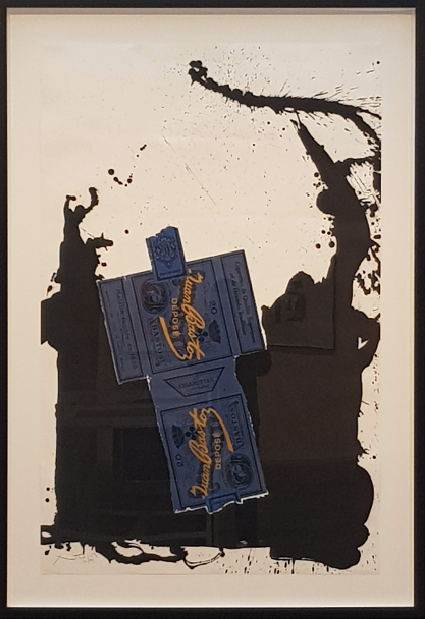
Artist: Robert Motherwell
Title: Bastos. Edition of 49
Year: 1975
Dimension: 158.4 x 101.6 cm
Technique: Lithograph on white mould-made paper
Price: TBC
About the Artist
Robert Motherwell (January 24, 1915 – July 16, 1991) was an American abstract expressionist painter, printmaker, and editor. He was one of the youngest of the New York School, which also included Philip Guston, Willem de Kooning, Jackson Pollock, and Mark Rothko.
Trained in philosophy, Motherwell became an artist, regarded as among the most articulate of the abstract expressionist painters. He was known for his series of abstract paintings and prints which touched on political, philosophical and literary themes, such as the Elegies to the Spanish Republic.
Text is taken from https://en.wikipedia.org/wiki/Robert_Motherwell
What does this work say (to me)?
Expressionism either in its abstract or figurative form always has had a big appeal to me.
Motherwell among my favorites in the abstract world.
There is a beautiful rhythm and somehow musical quality in the way the splashes of black ink take shape and organize on the paper’s surface.
There is this uneasiness I feel, a good one I need to say when I see his creations: regardless of what seems to be a trace consequence of a random, energetic force I can not but feel very clear intentionality, one that makes me think of a calculated, clear line of thought that has permeated and gave existence to the splash itself.
It is as if those patches of ink were alive like those cells one sees through the microscope that moves at their will in a very alien, autonomous manner.
On this lithograph the movement of this black ink has been affected by the presence of the vintage cigarettes’ wrapping paper (a reproduction of it) moving around it, recognizing its different materiality and giving it a starring role in the composition.
The contrast between the fluidity of the ink and the geometry of the wrapping paper creates a beautiful tension; again, what we supposedly may be seen as a random situation has all the power of intention expressing life itself.
What is extraordinary is that Motherwell uses not living things to express that energy and even though it can be felt, contained by the frame it is forced and kept in position by the paper that allowed it to be.
In what Room to place it?
Any room I would say but the bedroom. I say this because I find it so vibrant that I would be staring at it all the time making me a channel of its energy.
Displaying it
It is not a small piece so a good wall will be required, ideally, a room with depth and if surrounded by other artwork I would be very careful in no create lines that dissipate its energy. It has to be on its own.


