
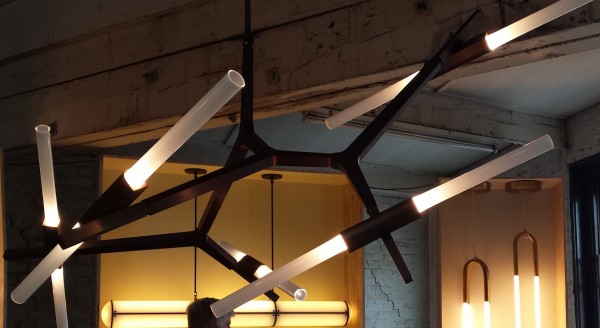
The concept of fractal as a module than repeats itself is used in the geometry of this pendant light as a “possibility”
The concept of fashion is a complicated one as it involves at the same time those that create it and those that follow it, and the gap of time and space between those two is not a big one when it is in its developing phase.
In interior design when something is fashionable we call it a trend.
The importance of understanding fashion or trends is not just based on the understanding of their aesthetic implications, in the creation of “looks”. They can be indicators of how a specific era fights for expressing itself, developing and creating its own distinctive language.
The aggressive pace with which technology has advanced in the XXI Century demands a strong response in terms of how the different creative fields digest and express it.
These are fascinating times.
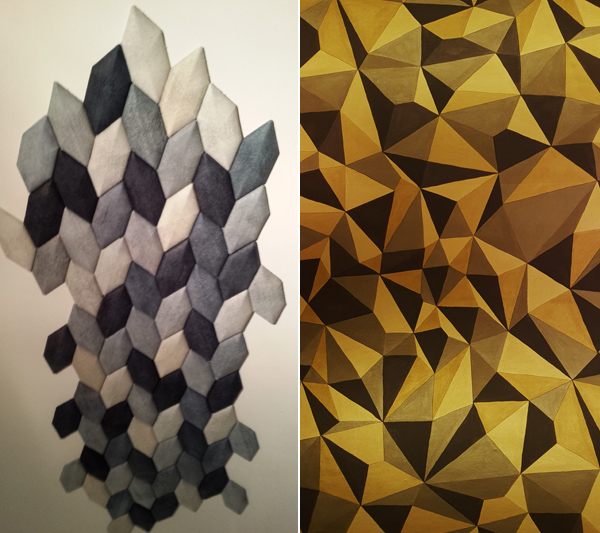
Wall panels and wallpaper are two of the options you have for incorporating fractals in your interiors.
How to express that complexity?
How to make obvious the power of technology?
One of the most wonderful achievements in the area of programming has been the possibility of calculating very complicated surfaces in a very short period of time making it possible to translate that “understanding” into surfaces and objects easy to acquire by all.
As a consequence, geometry has been one of the disciplines that has benefited hugely in this process and within it “fractals” and “parametric surfaces” are probably the most important.
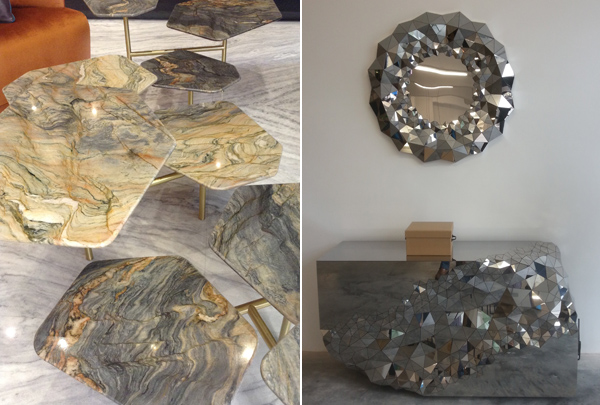
Furniture is embracing this kind of geometry either suggesting a fractal or showing it as part of its design.
Architecture has been leading this area, allowing us to see wonderful buildings like Federation Square in Melbourne or the Lisbon Portugal Train Station by architect Calatrava. Let’s not forget that the genius of Gaudi created one of the first Fractal structures without computer aid in the Sagrada Familia.
In terms of parametric surfaces Zaha Hadid made them one of the most well known ways of expressing XXI century architecture with buildings like The Baku Cultural Centre in Azerbaijan and The King Abdullah Financial District (KAFD) Metro Station in Saudi Arabia.
Why should interior Design escape the influence of this force?

Armchairs designed as a fractal or fabrics that explore that aesthetics for upholstery.
The use of fractals has influenced all areas of design: furniture, lighting, flooring, surfaces, tiling, etc.
Do you like the century you are living in?
Do you identify yourself with its energy, its force, its driving pace?
Are you in tune with the lines and shapes that define its existence?
If the answer is yes to any of these questions then you should embrace complex geometries in some way or another in your interiors.

Both of this objects even though embrace the aesthetic of fractals have not been produced following computer aid making process. Both of them are made by an artisan.
It does not need to be everywhere… that could be tiring and probably far from sophisticated, but incorporating some pieces within the design certainly will give to your interiors and to you an aura of understanding, actuality and taste reflecting the era we are living in.
I’m sharing with you some examples of objects and items where fractals have been used.
They can be seductive, beautiful, mesmerising, impactful and even sometimes contradictory.
Hope you enjoy them.
Bravo XXI Century!!!

Tiles, decorative, objects, rugs.. the possibilities of incorporating the beauty of fractals are limitless.


