
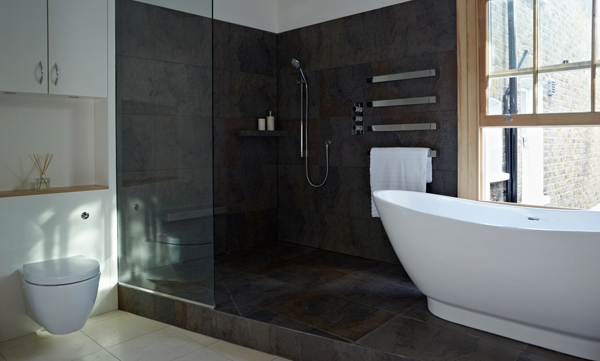
It was decided to have the wet and dry area defined by the tile. In the dry area a limestone tile was used, for the wet a porcelain tile emulating a slate look. Please notice the corners, they are mitred.
This is the last of a sequence of three posts dedicated to bathroom design and I would like to talk about tiling.
I have chosen tiling because it is a subject that many people consider self explanatory, the only decision being, what kind of tile to use.
Not at all!
There is much more than that when talking about tiling.
Let’s go to some of the points you need to pay attention to, or at least discuss with your builder.
Floor tiles and Wall tiles
Many suppliers have a clear division between these two, the wall tiles being either thinner or with more delicate finishes, as people won’t walk on them.
So floor tiles can be used as wall tiles but wall tiles should NOT be used as floor tiles. It is also worth checking if the wall is able to cope with the weight of floor tiles, in the case of marble for instance, which tends to be heavier and thicker than normal ceramic/porcelain tiles.

Mosaics were used for flooring and wall. Not all mosaics can be used on floors, usually those made of glass.
Strength of your floor/walls
So check if the floor and walls are strong and stable enough for the tiles to be installed on.
Weak joists usually cause the floor to move/bounce, which could lead to breakage within a few days of instalation.
Wet areas
Either in the shower tray area or bath areas, it is appropriate to use moisture resistance plasterboards or special water resistance boards and finally apply a tanking system which will help to avoid any problem you might have with water.
Please be aware when I say problem I mean a reasonable problem. If you leave your water running all night or day there is no special plasterboard that will be able to cope with an extreme situation like this.
Water is a powerful element as you know.
Choosing tiles
The format, dimensions, design, features, finish etc will depend on your taste and on what you want to achieve. Matt, glossy, porcelain, marble, wood, metal, etc. Options are many.
Pattern
This is a very important decision, as it will reinforce the nature of the design you are working on.
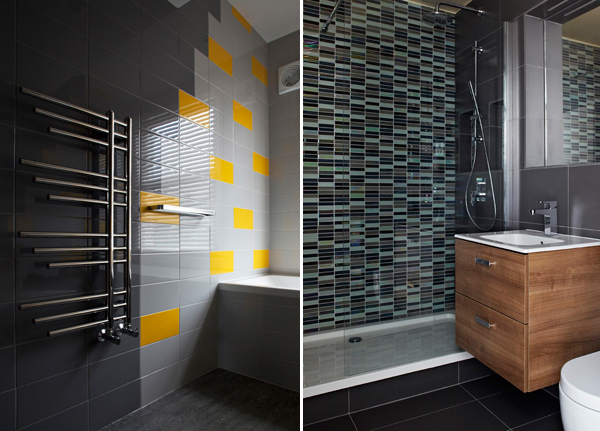
The pattern you choose for arranging your tiles will support the look and feel you want in an important way.
Grout
The colour and specification of the grout is a must for you to decide. The colour of the grout relates to the feel and look you are working on so it will vary accordingly. If you have glass tiles you will need to specify a more delicate grout so it does not scratch the glass when applied.
Trimmings
Oh this is so important.
What to do when two tiles meet at corners?
What to do when you need to leave one of the tile edges exposed?
The right answer is… it has to be designed
The less expensive option is to use trims, but it is not always the most elegant one.
Cutting the edge of the tiles at 45 degrees is my favourite option as for tiles to meet impeccably, this is the best solution. But this is not always possible either for cost reasons or due to the nature of the material.
In that case trims, overlaps and use of grout may offer a decent and good-looking solution. Every case must be studied independently.

Two options how you can solve the problem of tiles’ edge. The image on the left leave the edge exposed as being porcelain the colour of the tile can be seen throughout the material. The image on the right shows mitred corners.
Protection
It is always worth checking if the material you are using needs extra help to protect its surface.
Protection is a must when choosing stone tiles. In ceramic and porcelain tiles most of the time there is no need to use any product. However there is a product on the market that can be applied to these tiles once installed that reduces the possibility of them being slippery.
Maintenance
Finally if using special tiles like stone, wood, glass mosaics, etc, you need to check how to clean them so they have a long life.
If using stone tiles you will probably need to seal them every year.
Ask the question of your supplier.
As you can see tiling should not be left to chance. Poor tiling can destroy the whole effect, making your bathroom look cheap and basic, but well installed tiles will add beauty and perfection to your bathroom.


