
On my list there are many subjects I would like to write about but one of the most appealing to me is art and its presence in the home.
.jpg "Library, John Soane's house (1792), now John Soane's Museum. Here we can see how objects like vases and jars are placed at key places which let us know how interested the owner of this house was in Greek/Roman culture. Photo courtesy of the Trustees of Sir John Soane's Museum.")
Library, John Soane’s house (1792), now John Soane’s Museum. Here we can see how objects like vases and jars are placed at key places which let us know how interested the owner of this house was in Greek/Roman culture. Photo courtesy of the Trustees of Sir John Soane’s Museum.
.jpg "Interior Architecture: Diego Correa. Interior Design: Pedro Tagliafico. Even when art fulfil many times a decorative purpose as this could be the case due the harmonious colour scheme between space, furniture and art, in this case it tells us how an art proposal carefully arranged not just finish to shape the character of a space but make it unique as it is a reflexion of the ideas and interests of the owner.")
Interior Architecture: Diego Correa. Interior Design: Pedro Tagliafico. Even when art fulfil many times a decorative purpose as this could be the case due the harmonious colour scheme between space, furniture and art, in this case it tells us how an art proposal carefully arranged not just finish to shape the character of a space but make it unique as it is a reflexion of the ideas and interests of the owner.
We are used to seeing art in museums, galleries, parks and public buildings but, is the understanding or perception we have when standing in front of those works something we think we can have in our homes? Or is it something we have identified as alien to our day to day lives, something just to be experienced at the weekends because of the value of uniqueness given by those institutions? Is art something the majority thinks can only be found in museums and galleries and is therefore expensive and inaccessible?
Art is a relatively new concept as we understand it today; up to the XVII century art was the term used for describing skilfulness or craftsmanship in certain areas: there was no difference in appreciation if people compared the making of a knife with the making of a jewel or a sculpture therefore the name of the maker was not relevant. However, in the renaissance (XV-XVI century) a very important step was taken and art became the recognition of the artist as a person of special and unique talents. Art was not longer anonymous.
It was in the XVIII century with the creation of the Beaux arts, that the concept of art as we understand it was established. “The arts of the beautiful were separated from the arts of the useful because of the belief that the fine arts had a special quality: they served to give pleasure to an audience. The type of pleasure was called aesthetic, and it referred to the satisfaction given to the individual or group solely from perceiving–seeing or hearing–a work of art”. (R. A. Guisepi)
.jpg "The playfulness in choosing the photograph in the space does not minimise the quality of its proposal but enhances and somehow upgrade the informality of the furniture. Photography courtesy of Orde Eliason, photographer.")
The playfulness in choosing the photograph in the space does not minimise the quality of its proposal but enhances and somehow upgrade the informality of the furniture. Photography courtesy of Orde Eliason, photographer.
Whatever that pleasure can be varies according to the technology, the ideology and religion of a particular time: to how well a photograph represents a reality or momentum (Henri Cartier-Bresson), how a painting explores new ways of seeing things (impressionism or expressionism), how well it describes a subversive idea (like that of Duchamp with his urinal) or how accurately it expresses the horror of the war (as in the Picasso’s Guernica).
Art in this way triggers in us awareness, feelings, curiosity of that which is beyond the obvious, beyond our routine and reality. It takes us back to the level of what makes us special creatures: our unstoppable need to learn, feel and understand.
Our homes are or should be a projection of what we are, what we like and what makes us comfortable or inspires us. Practical objects like sofas or kitchens fulfil a purpose and talk about our taste but art talks about our ideas, our interest beyond the practicality of the material. It keeps us in touch with that immaterial world of the abstract associated with aspirations, ideals, dreams, illusions or just mere visual pleasure.
This is why I believe art needs to be an important part of our home, it talks about us. It does not need to be expensive; it could be a photograph, an engraving, the painting by young artist, a ceramic, an object displayed in a way that gives it a different meaning (conceptual art).
Because all these pieces are going to be expressing themselves they need to be placed in the right location so that their message can be easily explored by the viewer: the heights, what else is positioning nearby, the background, support and light all have to be considered.
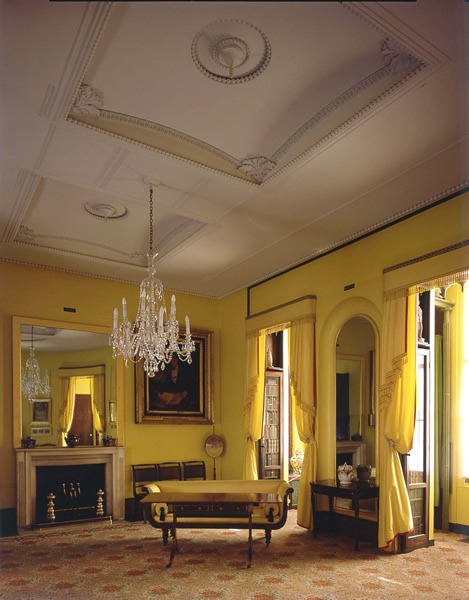
Drawing room, Soane’s house (1792), now John Soane’s Museum. Showing this room of an XVIII century house help us to understand how portraits at the time were a way not just of recognition of the importance of the seater but a statement of who you wanted to be identified with. Photo courtesy of the Trustees of Sir John Soane’s Museum.
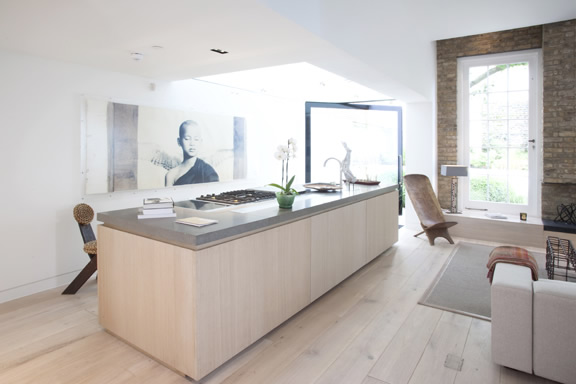
What could be just a kitchen is transformed by the art on the wall in a solid composition. Pay special attention and move your eyes from the light material of the floor, to the solid presence of the worktop to the ethereal feel of the photograph and its theme to the brightness of the light coming through the skylight. Photography courtesy of Orde Eliason, photographer.

Latelier Renault, Paris France. Photography courtesy of © Paul Raftery. I chose this image because I wanted to show how an common object displayed in a not conventional way awakes in us curiosity, it’s got sense of humour, you see elements you have not seen before, it just makes you feel you are discovering something new. Is this art? Probably not but it makes you feel many of the elements a good work of art should express to you.
Art speaks and it is our duty to give it the right to express itself, just as it is our choice to choose what we want to hear in our homes.
It is possible in our homes to have an experience similar to the one we have in museums or institutions. It is not the scale or the value given to art by institutions or by the market, it is the message that a work of art transmits to us and how open we are to receive it.


