

Chandelier Stream by Terzani. Photography courtesy of Terzani.Chandeliers have the spectacular factor in them. More than lamps, due to their dimensions, proportions and sense of scale they are lit up sculptures as this contemporary one suggests.
Nowadays everybody thinks of artificial light as something that we take for granted. It is totally embedded in the way we think of our cities and homes. It allows us to enjoy nights making the 24 hours of a day an endless source of activity and excitement.The control we have on it is so powerful that we rely completely on its availability.

Chandelier designed by Gareth Devonald Smith. Photography courtesy of Gareth Devonald Smith. As an interesting contrast to that of a classic chandeliers this design take lines, surfaces and materials and arrange them in a playful and elegant manner
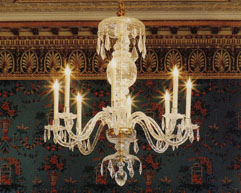
Chandelier designed and manufactured by Wilkinson PLC. Photography courtesy of Wilkinson PLC. Classic chandeliers made of crystal have a special niche in the market; they are in our sub conscience as synonymous of luxury and timeless properness.
The history of lighting runs parallel to the history of the sources we have used to make it possible: wood, coal, gas, batteries and electricity among them and is shaped or defined by the design of the object (bulb) giving light out when in contact with energy. This is the technical side of it but we need to take into account as well the history of how lighting is enclosed: the design of the lamp which changes depending on the style or fashion of the period.
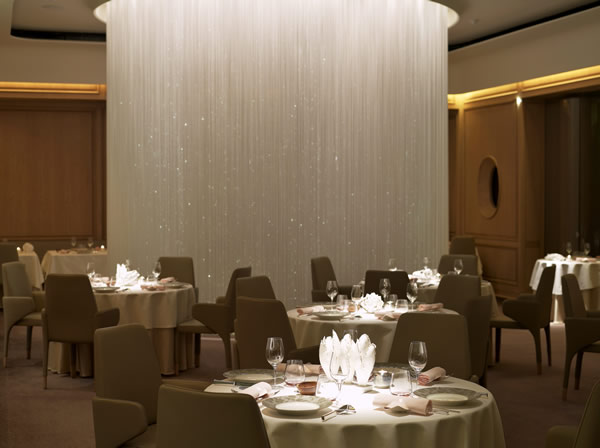
Dorchester Hotel, London. “Fibre optic equipment supplied by Crescent Lighting, design by Light and Design Associates” Photography courtesy of Crescent Lighting. Fibre optic is one of the most sophisticated ways of lighting as the object that is lit up is not the bulb but the element the light uses to travel: the fibre optic. It gives a huge versatility and flexibility to the design as this example shows.
So, in reference to the bulb we have incandescent, halogen, fluorescent, led or Oled ones. All of them with particular characteristics not just because of their technology and appearance but because of the sort of light they emanate: cold light (like that of the fluorescent lamp, white in colour) or warm light (like that of the halogen bulb, yellowish in colour). This is a point of vital importance to us the designers, as it is to going to affect directly the perception of colours and materials they light up.
The case of LED lighting is special as some years ago you just could only find cold led lights which were not very attractive for residential purposes, but now you can find them in warm light with different levels of brightness which have made the lives of eco friendly users much easier and pleasant.
When applying this knowledge to a particular space we need to consider additionally what we need the light for: for working, for relaxing, or a mixture of both? Do we want decorative lights for making the space more attractive and appealing? Or do we need special ones for accentuating a sculpture, a vase, a painting?

Topix LED light from Deltalight UK Ltd. Photography courtesy of Deltalight UK Ltd. Decorative lights like this could make a difference when working on a long wall, giving it a touch of informal elegance creating a rhythm of light and shadows.

Fin Light Round from Tom Dixon, Photography courtesy of Tom Dixon. Pendant lights always look good above fixed elements of a room: dining tables, breakfast and coffee tables. Special attention needs to be given to size, proportion, and how the light is casted on the surface bellow.
The answer to these questions is going to suggest the selection of different type of luminaries: down lights, pendant lights, wall mounted lights, floor lights, chandeliers or table lamps. Each of them fulfilling different needs: down lights arranged not far from each other, are going to cast a very nice even light. Pendant lights are good for emphasizing particular spots, chandeliers due to their spectacular design are placed for making statements, wall mounted lights create a nice bright rhythm without disturbing the eye; floor lights are very dramatic when close to walls, table lamps are fantastic as a warm indirect source of light and so on and so forth.

Doride Terra floor lamp by Artemide. Photography courtesy of Artemide. Floor lamps are invaluable pieces when direct light is required and you have the space to make it works. As chandeliers they work very well as objects themselves being sometimes close to the concept of sculpture all of us have: tri dimensional pieces to be admired.
The way we arrange them creates different kinds of lighting effects which is the aim of a very well lit space. An American lighting designer during the 50’s, Richard Kelly, summarised it in a way that is still valid when talking about these effects: ambient luminescence, focal glow and play of brilliants. (mondo magazine, 68, 2012).
The importance of good lighting cannot be underestimated. Its impact and effectiveness in making the dullest of the spaces come to life is very impressive. Let’s make no misunderstanding. Lighting does not make good architecture or good interiors but it certainly has the power to enhance them in a very unique way.
I think one of the many legacies of the Olympic Games has been to help us understand how vital the lighting design is in a project. The Olympics in China were about statements in architecture, the Olympics in London were about sustainability and lighting. The Olympic stadium was transformed from a functional shell during the day to a magical huge piece of crystal during the night, reflecting, projecting and displaying all the colours of the rainbow.
This is the closest we can be to pure magic. That is why light is so important. It always surprises us!


